
 TikTok
How Much Does a Slate Roof Cost in 2026? (Materials, Labour & Full Breakdown)
If you’re planning a re-roof and weighing up natural slate, the honest answer to “how much does it cost?” is: it depends heavily on slate origin, roof size, your location, and who you hire. This guide breaks down real 2026 UK figures for materials, labour, and everything else that ends up on your final invoice — so you can budget with confidence before you get quotes.
Quick Answer: Average Slate Roof Cost in 2026
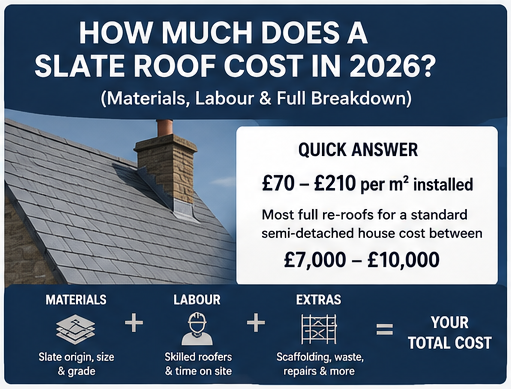
For a typical UK home, a fully installed slate roof costs somewhere between £70 and £210 per m², and most homeowners doing a full re-roof on a standard semi-detached house end up spending £7,000 to £10,000 in total. Premium options like Welsh slate sit at the top of that range; more affordable natural slate — Spanish, Brazilian, and Chinese — typically comes in lower, often between £70 and £150 per m² installed.
The wide range exists because “slate roof cost” is really three separate costs bundled together: the slate itself, the labour to fit it, and a set of additional costs (scaffolding, waste removal, timber repairs) that vary from job to job.
Materials Cost: What Slate Itself Costs
This is the part most homeowners underestimate the variation in. Slate isn’t a single product — origin, size, and grade all move the price significantly.
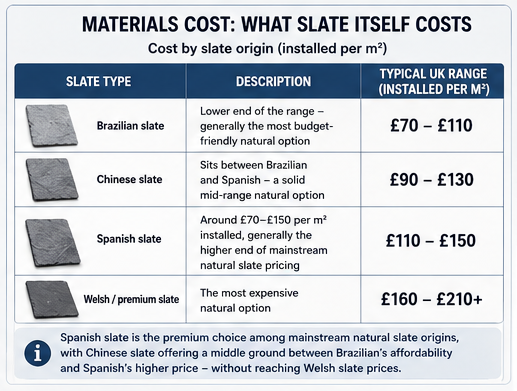
Cost by slate origin (per m², material only)
| Slate type | Typical UK market range (installed) |
|---|---|
| Brazilian slate | Lower end of the range — generally the most budget-friendly natural option |
| Chinese slate | Sits between Brazilian and Spanish — a solid mid-range natural option |
| Spanish slate | Around £70–£150 per m² installed, generally the higher end of mainstream natural slate pricing |
| Welsh / premium slate | £160–£210+ per m² installed — the most expensive natural option |
Spanish slate is generally treated as the premium choice among mainstream natural slate origins, with Chinese slate offering a middle ground between Brazilian’s affordability and Spanish’s higher price point — without stepping up to Welsh-slate prices.
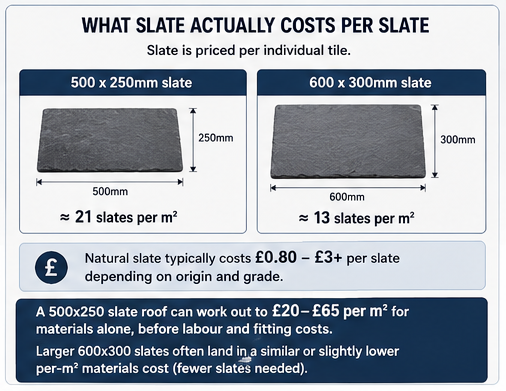
What slate actually costs per slate
Slate is sold and priced per individual tile, and the number of slates you need per m² depends on the size you choose:
- 500×250mm slate: approximately 21 slates per m²
- 600×300mm slate: approximately 13 slates per m²
Using current market pricing for natural slate — commonly ranging from roughly £0.80 to £3+ per slate depending on origin and grade — a 500×250 slate roof can work out to somewhere in the region of £20–£65 per m² for materials alone, before labour and fitting costs. Larger 600×300 slates often land in a similar or slightly lower per-m² materials cost, since fewer slates are needed to cover the same area, even though each slate costs more individually.
It’s worth comparing supplier pricing directly rather than relying on averages — material costs vary more between suppliers than most other parts of the job, and buying slate independently (rather than through a roofer’s supply-and-fit price) is often one of the easiest ways to bring the total cost down.
Labour Cost: What You’re Paying a Roofer For
Slate roofing requires more skill than fitting concrete or clay tiles — slates need to be hand-graded, cut, and fixed individually, which is reflected in labour rates.
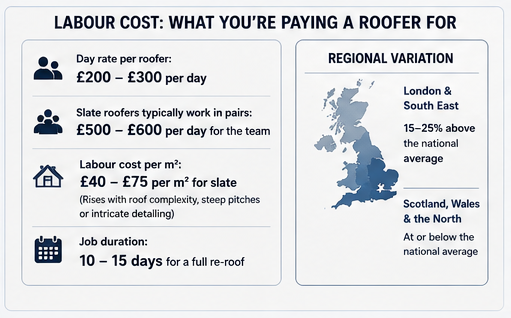
- Day rate per roofer: £200–£300 per day
- Slate roofers typically work in pairs, so budget £500–£600 per day for the team
- Labour cost per m²: roughly £40–£75 per m² for slate specifically, though this rises with roof complexity, steep pitches, or intricate detailing
- Job duration: a full re-roof typically takes 10–15 days depending on property size and access
Regional variation matters
Labour costs are not uniform across the UK:
- London and the South East: typically 15–25% above the national average
- Scotland, Wales, and the North: generally at or below the national average, though conservation area requirements (see below) can still push costs up regardless of region
Full Cost Breakdown by Property Size
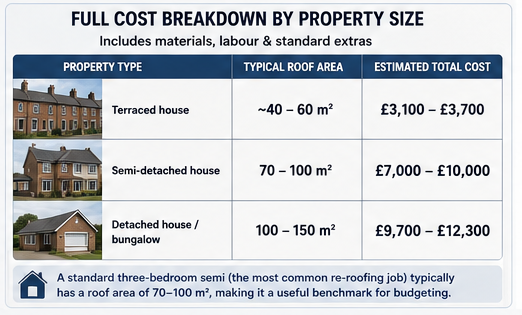
Here’s what a complete slate roof replacement typically costs once materials, labour, and standard extras are included:
| Property type | Typical roof area | Estimated total cost |
|---|---|---|
| Terraced house | ~40–60 m² | £3,100–£3,700 |
| Semi-detached house | 70–100 m² | £7,000–£10,000 |
| Detached house / bungalow | 100–150 m² | £9,700–£12,300 |
A standard three-bedroom semi — the most common UK re-roofing job — typically has a roof area of 70–100 m², making it a useful benchmark for budgeting.
Extra Costs That Often Get Left Off Initial Quotes
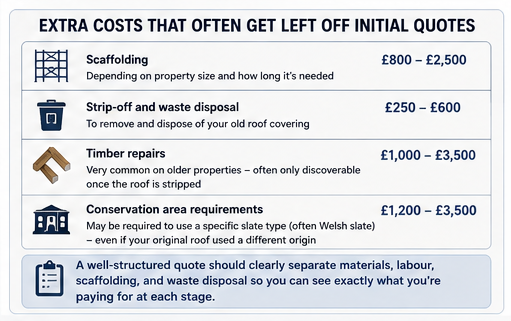
A quote that only covers slate and fitting isn’t the full picture. These are the additions that regularly surprise homeowners partway through a project:
- Scaffolding: £800–£2,500, depending on property size and how long it’s needed
- Strip-off and waste disposal: £250–£600 to remove and dispose of your old roof covering
- Timber repairs: budget an additional £1,000–£3,500 if your roof structure (battens, rafters, or joists) needs attention once the old covering is removed — this is very common on older properties and is often only discoverable once the roof is stripped
- Conservation area requirements: if your property sits in a conservation area or under an Article 4 direction, you may be required to use a specific slate type (often Welsh slate specifically) even if your original roof used a different origin — this can add £1,200–£3,500 in material premium alone
A well-structured quote should clearly separate materials, labour, scaffolding, and waste disposal, so you can see exactly what you’re paying for at each stage.
Slate vs Other Roofing Materials: A Cost Comparison
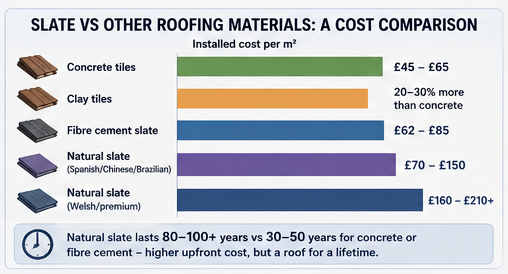
If you’re still deciding between slate and alternatives, here’s how it stacks up:
| Material | Installed cost per m² |
|---|---|
| Concrete tiles | £45–£65 |
| Clay tiles | 20–30% more than concrete |
| Fibre cement slate | £62–£85 |
| Natural slate (Spanish/Chinese/Brazilian) | £70–£150 |
| Natural slate (Welsh/premium) | £160–£210+ |
Slate costs more upfront than concrete or fibre cement, but it’s worth weighing that against lifespan: natural slate commonly lasts 80–100+ years, compared to 30–50 years for concrete or fibre cement. Over the lifetime of a roof, slate’s higher initial cost is often offset by the fact that you’re unlikely to ever need to replace it again — where concrete or fibre cement roofs may need replacing once or even twice within the same period.
How to Keep Costs Down Without Cutting Corners
- Source slate independently rather than through a roofer’s supply-and-fit markup — comparing per-slate pricing across suppliers can meaningfully reduce your materials bill
- Time repairs with your re-roof. If timber repairs are likely, doing them while scaffolding is already up avoids paying for scaffold hire twice
- Get multiple quotes that itemise labour, materials, and extras separately — this makes it far easier to spot where one quote is inflated relative to another
- Ask about slate origin specifically. Brazilian, Chinese, and Spanish slate can all offer genuine natural-slate durability at a materials cost well below Welsh slate, with pricing that scales by origin — giving you room to balance budget and quality without sacrificing the longevity that makes slate worth choosing in the first place
Final Thought
A slate roof is one of the more expensive re-roofing choices upfront, but it’s also one of the only roofing materials genuinely capable of lasting a lifetime. Understanding exactly where your money goes — materials, labour, scaffolding, and the extras that tend to surface once work begins — puts you in a much stronger position when comparing quotes and deciding what’s right for your property and budget.
If you’re at the stage of comparing slate prices directly, our slate range is a useful starting point for seeing current per-slate pricing across Brazilian, Chinese, and Spanish options.
Cost figures are based on UK market data current as of 2026 and are intended as a general budgeting guide. Actual costs will vary by property, location, and supplier — always get itemised quotes from qualified roofers before committing to a project.